
Healthcare Management App

Designing a mobile health record flow for caregivers and patients who manage scattered medical information.

A mobile UX concept that brings prescriptions, lab reports, medication schedules, appointments, and emergency support into one organized care-management experience.

Overview

Role and context

This project explored how caregivers and patients manage medical information across paper files, messaging apps, notes, and photo galleries, then translated those patterns into a centralized mobile experience.

Problem statement

Caregivers and patients need quick access to prescriptions, reports, medication reminders, and appointment details. When that information is scattered across formats, routine care takes more effort and urgent situations become harder to manage.

Audience

Caregivers, patients, and medical assistants managing prescriptions, records, appointments, and emergency healthcare information.

Interaction focus

Centralized medical records, medication reminders, timeline tracking, and privacy-aware healthcare coordination on mobile.

Case study role

Shows UX research, persona development, prototyping, and usability evaluation for a complex healthcare management problem.

Honesty note

Concept project based on interviews, ideation, and usability evaluation. Clinical outcomes and implementation metrics are outside this project scope.

Process

From scattered records to a clearer care-management flow.

The process combined user interviews, workflow analysis, paper prototyping, heuristic evaluation, and cognitive walkthroughs. Each step focused on retrieval speed, privacy, and support for shared caregiving tasks.

Identified fragmented healthcare workflows

Research showed users storing prescriptions, reports, reminders, and appointment details across paper files, messaging apps, notes, and photo galleries.

Outcome: Prioritized a single place to upload, label, retrieve, and share medical information.

Mapped caregiver and patient journeys

Created caregiver and medical assistant personas to understand coordination needs, time pressure, and access patterns.

Outcome: Shaped flows around family profiles, time-sensitive access, and repeat medication tasks.

Explored multiple interaction directions through ideation

Crazy 8 exercises and storyboards compared structures for medical documents, reminders, timelines, and emergency support.

Outcome: Selected category-based navigation and timeline patterns that matched how users already organize care.

Built low-fidelity and paper prototypes

Paper prototypes and low-fidelity wireframes tested uploading records, viewing prescriptions, tracking medication, and managing appointments.

Outcome: Validated navigation, hierarchy, and task sequence before high-fidelity design.

Refined the experience through usability testing

Heuristic evaluation and cognitive walkthroughs surfaced issues in navigation labels, hierarchy, spacing, and discoverability.

Outcome: Guided updates to dashboard structure, record cards, feedback states, and navigation consistency.

Key decisions

Design Decisions That Shaped the Healthcare Flow

The key decisions focused on quick recognition, shared caregiving, privacy, and consistent mobile patterns for sensitive healthcare tasks.

Centralized medical information into one system

Medical documents, prescriptions, medications, appointments, and emergency information were grouped in one mobile system.

Impact: Supported faster retrieval during appointments, routine medication checks, and urgent care moments.

Prioritized recognition over recall

Dashboard layouts used category icons, cards, timeline views, and visual grouping to support scanning.

Impact: Helped users locate records through visible categories and recent activity.

Designed for both caregivers and individual users

The experience supported caregivers managing multiple family members and individuals managing their own care.

Impact: Created a flexible structure for family profiles, medication reminders, and appointment context.

Used privacy-aware interaction patterns

Reminder systems, medication notifications, and record views used discreet language and compact previews.

Impact: Made sensitive health tasks feel calmer in shared and public settings.

Created a consistent mobile-first design system

The interface used readable typography, structured spacing, reusable components, and simplified navigation.

Impact: Kept repeated tasks predictable across records, reminders, appointments, and emergency support.

Screen designs

Prototype Mockups

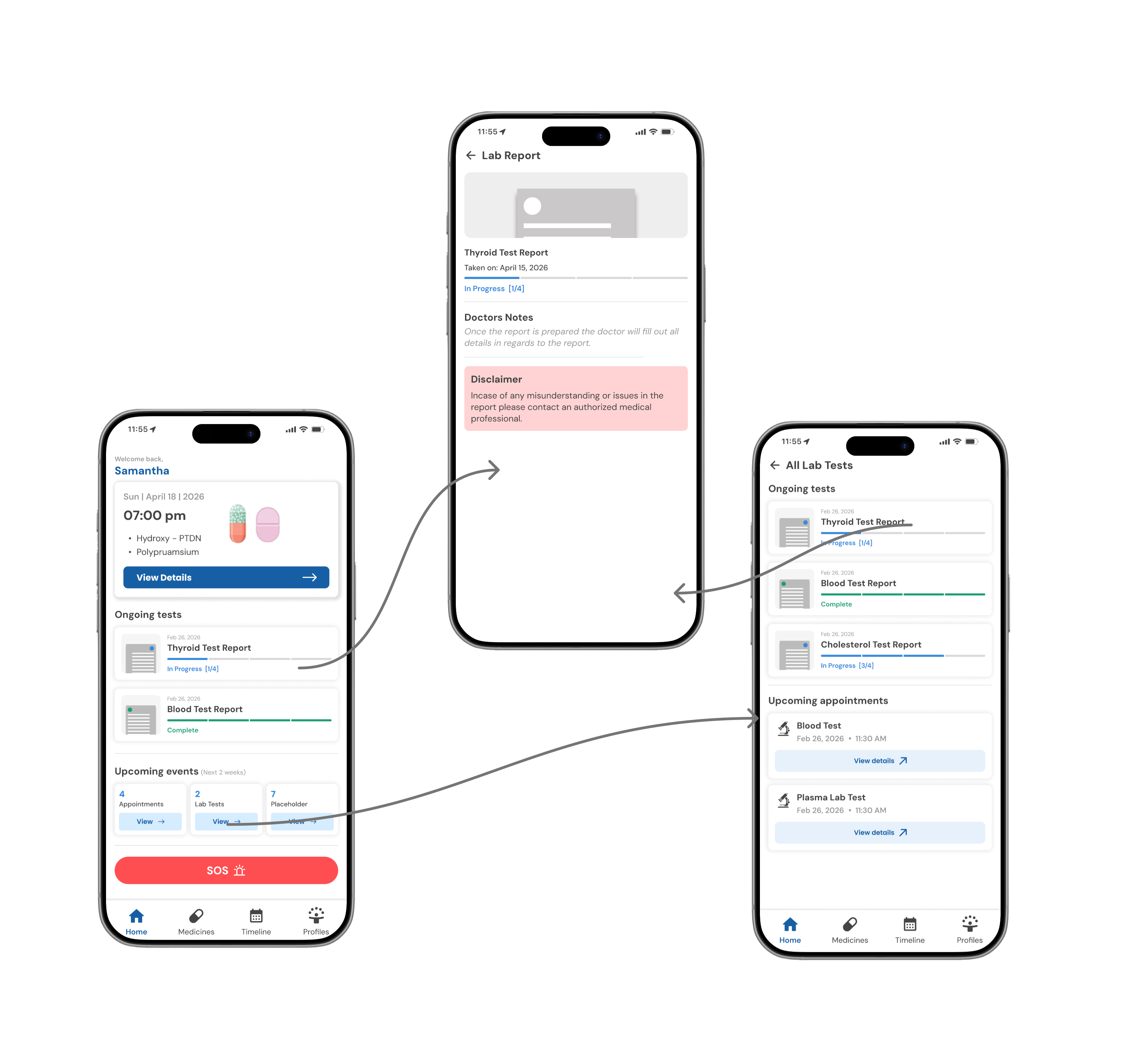
A mobile healthcare management flow showing home, lab report, and lab test screens.

Open Figma Prototype
Healthcare app prototype flow showing home, lab report, and all lab tests screens in iPhone mockups

Outcome

What the Project Improved

The project shows how a centralized mobile structure can make healthcare information easier to scan, retrieve, and act on during routine and urgent care.

Improved access to medical information

Users could upload, organize, retrieve, and manage prescriptions, reports, medicines, and appointment histories from one place.

Reduced cognitive load during healthcare tasks

Categorized records, medication reminders, timeline tracking, and structured dashboards reduced the amount users had to remember.

Created clearer medication management workflows

Medication schedules, dosage details, reminders, and tracking cards made daily medication tasks easier to review.

Improved user confidence through organized systems

Testing indicated that timeline-based records and medicine cards were easy for participants to understand quickly.

Supported both routine and emergency healthcare needs

Emergency SOS, location sharing, and quick document retrieval extended the flow to time-sensitive healthcare needs.

Open Report PDF

Reflection

What I Would Improve Next

Next, I would test the prototype with caregivers, patients, and healthcare professionals to evaluate retrieval speed, accessibility, trust, and shared-account workflows in realistic care scenarios.

I would also explore:

  • •Testing the system across larger and more diverse healthcare user groups
  • •Improving accessibility compliance and readability standards
  • •Refining privacy controls for shared and public environments
  • •Expanding interoperability with hospitals and healthcare providers
  • •Measuring long-term effects on cognitive load and healthcare task efficiency

Contact

Let's Connect

I would love to hear from you whether it is about design or new opportunities. Always excited to connect and share ideas.